Search This Blog typing in English or Telugu, and sometimes Hindi

Showing posts with label Mahabhagavata. Show all posts

Monday, February 12, 2018

1047 (Part 1/10 series) Why Sanskrit Vyasa Mahabhagavata, 7th Canto has not mentioned "Ayodhya" as a place of pilgrimage?


Clarfication: Primarily, I am a student of History, having completed my PG after my retirement from Banking Profession. I greatly appreciate our mythologies and scriptures. At the sametime, I feel that there is a need for Indians to become truth seekers instead of continuing as blind believers throughout their lives. I believe that Valmiki Ramayana has many components of history, which can be picked up after eliminating elements of fantasy such as Pushpaka Aircraft. In the same way, Vyasa Mahabharata and Vyasa Mahabhagavata seem to have many components of history, which can help us in making comparisons of one Century with another Century, and arrive at features of evolution of Indian Culture, such as places of pilgrimage. AyOdhya (also called sAkEt etc.) the birth place of Lord Shri Rama is one place which is hidden under the Earthy Mounds of Archaeological Sites. The AyOdhya may be the Phyzabad Ayodhya in U.P., or some other place in Bihar, Jharkhand.

VyAsa Mahabhagavata Sanskrit Language, 7th Canto (saptama skantha), Verses 30 to 33.
saramsi pushkarAdini
kshetrANy arhASritAny uta
kurukshetram gaya-Sirau
prayAgau pulahASramau
naimisham phAlgunam setuu
prabhAso atha kuSa-sthali
vArANasi madhu-puri
pampA bindu-saras tathA
nArAyaNASramo nandA
sitA-rAmASramAdayau
sarve kulAcalA rAjan
mahendra-malayAdayau
ete puNyatamA deSA
harer arcASritAS ca ye
etAn deSAn nisheveta
Sreyas-kAmo hy abhikshNaSau
dharmo hy atrehitau pumsam
sahasrAdhi-phalodayau


To save my labor, I am giving below the English Translation of the above verses, courtesy: Late Shrila Prabhupada of Harekrishna Movement


saramsi—lakes; pushkara-Adini—such as Pushkara; kshetrANi—sacred places (like Kurukshetra, GayAkshetra and JagannAtha Puri); arha—for worshipable, saintly persons; ASritAni—places of shelter; uta—celebrated; kurukshetram—a particular sacred place (dharma-kshetra); gaya-Sirau—the place known as GayA, where GayAsura took shelter of the lotus feet of Lord VishNu; prayAgau—Allahabad, at the confluence of the two sacred rivers Ganges and YamunA; pulaha-ASramau—the residence of Pulaha Muni; naimisham—the place known as NaimishAraNya (near Lucknow); phAlgunam—the place where the PhAlgu River flows; setuu—Setubandha, where Lord RAmacandra constructed a bridge between India and LaìkA; prabhAsau—PrabhAsakshetra; atha—as well as; kuSa-sthali—DvAravati, or DvArakA; vArANasi—Benares; madhu-puri—MathurA; pampA—a place where there is a lake called PampA; bindu-sarau—the place where Bindu-sarovara is situated; tathA—there; nArAyaNa-ASramau—known as BadarikASrama; nandA—the place where the NandA River flows; sitA-rAma—of Lord RAmacandra and mother SitA; ASrama-Adayau—places of shelter like CitrakUTa; sarve—all (such places); kulAcalAu—hilly tracts of land; rAjan—O King; mahendra—known as Mahendra; malaya-Adayau—and others, like MalayAcala; ete—all of them; puNya-tamAu—extremely sacred; deSAu—places; hareu—of GOD ; arca-ASritAu—places where the Deity of RAdhA-KrishNa is worshiped (such as big American cities like New York, Los Angeles and San Francisco, and European cities like London and Paris, or wherever there are centers of KrishNa consciousness); ca—as well as; ye—those which; etAn deSAn—all these countries; nisheveta—should worship or visit; Sreyau-kAmau—one who desires auspiciousness; hi—indeed; abhikshNaSau—again and again; dharmau—religious activities; hi—from which; atra—in these places; ihitau—performed; pumsAm—of the persons; sahasra-adhi—more than a thousand times; phala-udayau—effective.

The sacred lakes like Pushkara and places where saintly persons live, like Kurukshetra, GayA, PrayAga, PulahASrama, NaimishAraNya, the banks of the PhAlgu River, Setubandha, PrabhAsa, DvArakA, VArANasi, MathurA, PampA, Bindu-sarovara, BadarikASrama [NArAyaNASrama], the places where the NandA River flows, the places where Lord RAmacandra and mother SitA took shelter, such as CitrakUTa, and also the hilly tracts of land known as Mahendra and Malaya—all of these are to be considered most pious and sacred. Similarly, places outside India where there are centers of the KrishNa consciousness movement and where RAdhA-KrishNa Deities are worshiped must all be visited and worshiped by those who want to be spiritually advanced. One who intends to advance in spiritual life may visit all these places and perform ritualistic ceremonies to get results a thousand times better than the results of the same activities performed in any other place.

In these verses and in verse twenty-nine, stress is given to one point: harer arcASritAS ca ye or harer arcA. In other words, any place where the Deity of GOD is worshiped by devotees is most significant. The KrishNa consciousness movement is giving the population of the entire world a chance to take advantage of KrishNa consciousness through the ISKCON centers, where one may perform Deity worship and chant the Hare KrishNa mahA-mantra and in this way obtain results with effectiveness increased a thousand times. This constitutes the best welfare activity for human society. This was Sri Caitanya MahAprabhu's mission as it was predicted by Him in the Caitanya-bhAgavata (Antya 4.126):

prithivite Ache yata nagarAdi-grAma
sarvatra pracAra haibe mora nAma

Sri Caitanya MahAprabhu wanted the Hare KrishNa movement, with installed Deities, to spread to every village and town in the world, so that everyone in the world might take advantage of this movement and become all-auspicious in spiritual life. Without spiritual life, nothing is auspicious. MoghASA mogha-karmANo mogha gnAnA vicetasau (Bg. 9.12). No one can become successful in fruitive activities or speculative knowledge without being KrishNa conscious. As recommended in the SAstras, everyone should be very eagerly interested in taking part in the KrishNa consciousness movement and understanding the value of spiritual life.


I am not a supporter or hater of Harekrishna Movement.

ybrao-a-donkey's personal view, not intended to be imposed on others


In the above list of places of pilgrimages, we do not find the name of Ayodhya or the Birth place of Shri Rama. There is a reference to Sita Rama Ashrama (Hermitage of Sita, Rama and Lakshmana during their Forest Exile). Shrila Prabhudasa has also mentioned above ChitrakooTa which is on the boundary of Uttar Pradesh and Madhya Pradesh. But these three verses, why they have ignored Ayodhya?

At the time of Evolution of Vyasa Mahabhagavata as a scripture i.e. probably the Gupta Period i.e.the 3rd & 4th Centuries A.D., which is also considered as a Golden Age for India. Were Chandra Gupta-I, Samudra Gupta, Chandra Gupta-2 aware of the Existence of Ayodhya as the Birth place of Shrirama and as a place of pilgrimage?

Only 10% completed. Shall come back, continue adding, deleting, modifying.

Wednesday, June 28, 2017

1012 Links sent by my friend, who it appears wants to prove that Indian Caste System has great qualities


Our learned friend who greatly admires the Indian Civilisation, including its discriminative and oppressive Caste System, has sent us seven links to web pages which try to prove the Greatness of Indian Caste System. Well, I respect their right to express their perspectives and view points. In law, we have a very popular maxim, which says "Audi Alterim Partem' (Hear the other Party). Hearing the other persons, whether we accept whatever they say/write or not is, very important. I am unable to spare much time and space to answer bulk of the issues raised therein. Of course, my Readers will be free to visit those linked pages, and their comments there itself. Alternatively, if my readers have any questions to ask me, who has an atheist-Marxist bias, I shall definitely try to answer them to the best of my ability.

Links received by me:

Click here to go to http://indiafacts.org/varna-not-caste/

Click here to go to http://indiafacts.org/varna-caste-analysis-ii/

Click here to go to http://indiafacts.org/analysis-varna-caste-part/

http://indiafacts.org/varna-provide-religious-basis-present-caste-system/

http://indiafacts.org/why-is-the-world-so-obsessed-with-indias-caste-system/

Click here to go http://indiafacts.org/hinduism-and-caste-a-counter-narrative/

Click here to go to http://indiafacts.org/caste-system-colonial-idea/


Personal views of ybrao-a-donkey, not intended to be imposed on others

The Aryan Immigrants into India were very much concerned about 'color of body', just as today's EuramANZ's some Racial Whites are concerned, and worried, about immigrations from Body-Browns and Body-Blacks. Varna in Sanskrit language, though has several meanings, in the context of Caste System, the meaning is 'body color', with the light colors white-red-yellow reserved to Upper Castes. I have already posted at this blog, the Sanskrit Verses from vyAsa Mahabharata which proved that the Mahabharata characters were very much concerned about body colors.

Link to the particular blog post:

In Telugu language, we have two words which refer to caste of persons. Scholars, and Temple Preachers use the word 'varNa' synonymously with 'kulam'. Commonly used word 'kula' or 'kulam' has in addition to the meaning of caste, also refers to 'clan, dynasty, successive generations' which again has another synonym, 'vamSam'. Nowadays, Telugu Press Media and Electronic Media have started using the phrase 'sAmAjika vargam' to refer to birth castes in their analyses, particularly political analyses. sAmAjika= Social. vargam=Class. This phrase is euphemistic, and both the Print and Elec. Media seem to want appear to be 'holier than they'. Or else, why a long phrase, instead of a simple 2 letter word 'ku-la' or 'ku-lam'. In Hindi, I have come across the word 'jAti' to mean caste. This jAti is a direct derivative of the root 'janana' = birth.

The first linked page above, "indiafacts.org/varna-not-caste", by Shri David Frawley, says that there is something 'yogic' in the Indian Caste System. I believe that there is nothing of that sort. I shall quote from Shri David Frawley:
The Hindu Varna system has a unique yogic orientation beyond outward class divisions.The Vedic goal of life is the realization of Cosmic Consciousness within the individual, for which the practice of Yoga and meditation is prescribed which includes detachment from the outer goals of life. Varna is meant to aid in the individual process of Self-realization and not become an end-in-itself. To reach that Universal Self one must give up identification with any social group.

The goal of a Vedic life, achieved through the practice of Yoga and meditation, requires going beyond worldly desires to a state of inner freedom (Moksha) and union with the Cosmic Person or Purusha. This Hindu social goal of Moksha is very different from western social orders that exist for the fulfillment of worldly desires, emphasizing social, political and material gains. It is also different from the ordinary religious goal of going to heaven, which is based upon a continuity of the ego and human identity, not a realization of the Universal Self within us.

The capitalist model that dominates the world today is such a desire-based materialistic social order that is ignorant of our deeper consciousness. While capitalism provides outer freedom, it follows an external view of reality that blinds us to our inner nature, and gets us caught in the pursuit of enjoyment that inevitably ends in sorrow and death.


yb-a-donkey: 'VarNa' (Caste or Body Color, or whatever else it meant), has nothing YOGIC + MEDITATIONs, and to do with Self-Realisation of Individuals. The problem with most of the Ancient Indian Scriptures is, they contain everything under the sky, including imagined concepts, irreconcilable concepts. Indian Civilisations, through every millennium, through every Century, went through 'desire-based social orders' like their Western Counterparts. Consequently, throughout all these millennia(ums), Centuries, has acquired and retained its characteristic of 'Oppression of the Lower Castes'. The Top castes wanted to enjoy at the cost of the lower castes who were condemned to 24x7x365 lifelong slaveries.

Question: Prove about the oppressive slavery imposed by scriptures?


Ans: Here are some verses from Vyasa Mahabhagavata which clearly shows the Slavery imposed on the 4th caste persons (SUdrAs).
Vyasa Mahabhagavata PART 11, CHAPTER 17, VERSE 19, SANSKRIT:

SuSrUshaNam dvija
gavaam devAnAm
ca apy amAyayA
tatra labdhEna santOshaha, SUdra-prakritayas tv imA ha.

VERSE 49

sUdra-vruttim bhajEd
vaiSyaha, SUdraha
kAru-katha-kriyAm
kricchrAn muktO na
garhyEna vruttim
lipsEta karmanA.

ENGLISH GIST: Serving the Priests, cows, Gods, without cheating and being happy with whatever he gets -- these are the duties of a SUdra (Fourth caste). A fourth caste person who cannot find a master to serve, can overcome his difficult situation by weaving baskets and straw mats. Again they should revert back to their original occupations after normalcy occurs. (That means a fourth caste person should find a master and serve again).


Evils of Capitalist System 'desire-based materialistc social order' cannot justify the continuation of the fissiparous and oppressive Indian Caste System. In fact, Capitalist System, Feudalist System, Caste System are like TRIPLETS in India, out on their rampage to exploit the Working Class. For this reason only I advocate the Abolition of Capitalism, Feudalism, and Casteism, which is possible through implementation of True Total Socialism.

The Fifth above Linked Webpage by Ms. Sahana Singh, titled "indiafacts.org/why-is-the-world-so-obsessed-with-India's-caste-system/"


This web page straight away questions why the World is obsessed with Indian Caste System. Actually, this question should be re-written as: "Why Indians are obsessed with their castes?".

Ans: 1. Vote Bank Politics. 2. Job Reservations. 3. Enslaving and Exploitation of Working Classes which do not own lands / factories / Shopping Complexes / Businesses.

To come back and continue adding / deleting / modifying.

Monday, June 26, 2017

1010 Where is it laid down in Vyasa Mahabhagavata that different castes emerged from diferent parts of Lord?


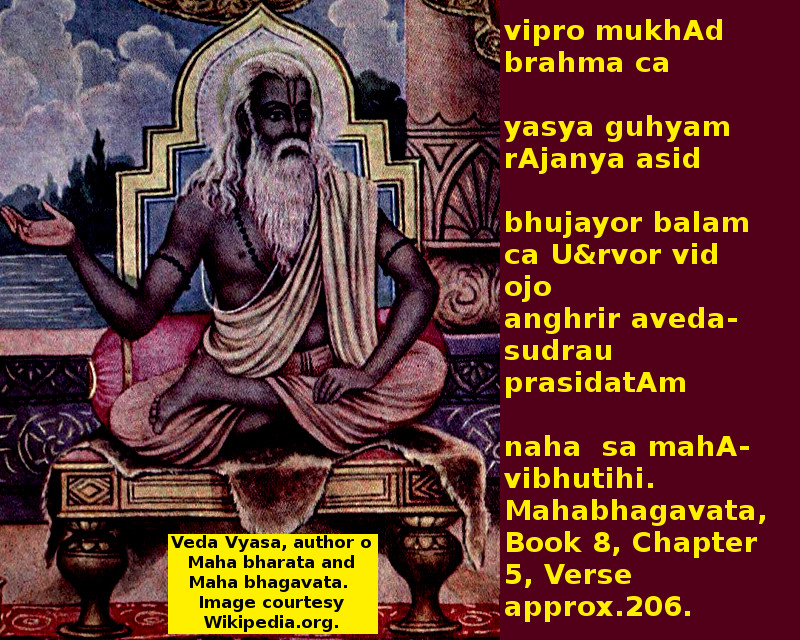
Where is it laid down in Vyasa Mahabhagavata, that Brahmin's (Priests caste) have emerged from Lord's Head, Kshatriyas (Warrior caste) have emerged from Lord's shoulders, Vysyas (Merchant and Landlord caste) have emerged from Lord's thighs, and SUdrAs (Servants caste) have emerged from Lord's feet? Answer for the question can be seen at Vyasa Sanskrit Mahabharata, Book 8 (ashTama skantha), Chapter 5, Verses approx. No. 207.

vipro mukhAd brahma ca yasya guhyam
rAjanya asid bhujayor balam ca
Urvor vid ojo anghrir aveda-sudrau
prasidatAm naha sa mahA-vibhutihi.

The Brahmins (Priests caste) and Vedic knowledge come from the mouth of the Supreme Personality of Godhead.
The kshatriyAs (warrior caste) and bodily strength come from His arms.
Vaisyas (Merchant caste) and their expert knowl­edge in productivity and wealth come from His thighs.
SUdrAs (Servant caste), who are outside of Vedic knowledge, come from His feet. May that Supreme Personality of Godhead, who is full in prowess, be pleased with us.


ybrao-a-donkey's personal views, which are not intended to be imposed on others:-


Though Sanskrit is not a dead language as many people perceive it to be, its daily usage in private homes and in public places, is rather limited. But it is extensively used in temple worships, Hindu family functions such as marriages, funerals, Opening of third eye ceremonies (upa-nayanams), initiating education to children ceremonies (aksharA- abhyAsa), etc. etc. Some of these are also called SamskArams.

There are many Indian languages (those which are recognised by Government of India/ Indian Constitution, and those which are not recognised), which have extensive literature. Unfortunately I do not know them, except my mother tongue Telugu and our National Language Hindi. Hence, I am quoting from a Telugu translation of Mahabhagavata, done by Bammera pOtnAmAtya, 15th Century CE circa.
వ. మఱియు, నెవ్వని బలంబున మహేంద్రుండును, ప్రసాదంబున దేవతలును, గోపంబున రుద్రుండును, బౌరుషంబున విరించియు, నింద్రియంబులవలన వేదంబులును మునులును, మేఢ్రంబునఁ బ్రజాపతియు, పక్షంబున లక్ష్మియు, ఛాయవలనఁ బితృదేవతలును, స్తనంబులవలన ధర్మంబును, బృష్ఠంబువలన నధర్మంబును, శిరంబువలన నాకంబును, విహాసంబువలన నప్సరోజనంబులును, గుహ్యంబువలన బ్రహ్మంబును, ముఖంబువలన విప్రులును, భుజంబువలన రాజులును (బలంబును), నూరువులవలన వైశ్యులును (నైపుణ్యంబును), పదంబులవలన శూద్రులును (అవేదంబును), అధరంబు వలన లోభంబును, నుపరి రదచ్ఛదంబువలనఁ బ్రీతియుఁ, నాసాపుటంబువలన ద్యుతియు, స్పర్శంబునఁ గామంబును, భ్రూయుగళంబున యమంబును, బక్షంబునఁ గాలంబును సంభవించె, నెవ్వని యోగ మాయా విహితంబులు ద్రవ్య వయః కర్మ గుణ విశేషంబులు, చతుర్విధ భూత సర్గం బెవ్వని యాత్మతంత్రంబు, నెవ్వని వలన సిద్ధించి, లోకంబులును లోకపాలురుం బ్రతుకుచుందురు, పెరుఁగుచుందురు, దివిజులకు నాయువు బలంబునై,జగంబులకు నీశుండై, పరమ మహాభూతి యగు నప్పరమేశ్వరుండు మాకుం బ్రసన్నుండగుఁ గాక! అని మఱియును.

Approx. English GistAnd, by virtue of whose strength the Chief of Demy-Gods Mahendra was born, whose grace demy Gods were born,
from whose anger Lord Shiva was born,
from whose valor Creator Brahma was born,
from whose organs were born vEdas and Sages,
from whose penis were born prajApatis (Literal meaning: Masters of People, but the meaning I am fond of eliciting: The first generation humans),
from whose chest was born the Goddess of Prosperity 'Lakshmi', from whose shadow were born Gods of Ancestry(-stors),
from whose breasts were born 'duty and virtuosity',
from whose hips was born 'injustice',
from whose head was born the heaven,
from whose laughter was born- the companies of nymphs,
from whose loins was born the 'infinite Supreme Spirit',
from whose face were born- the Brahmins (Priest Class),
from whose shoulders were born- the kshatriyas (Warrior Caste),
from whose thighs were born- the Vysya caste (Merchants and Agriculturists),
from whose feet were born- the SUdras and avEda (the Servant Caste, and whatever is non-vEdic),

from whose lower lips was born covetousness and temptation,
from whose upper lips were born- love and affection,
from whose nostrils was born radiance and sheen of body,
from whose touch emerged lust,
from whose eye-brows were born- the self-control and self-restraint ([Note: Shri Prabhupada in his English Translation of Sanskrit Mahabhagavata, took the English meaning of 'yama' in the same context as 'yama rAja' (the God of Death). But the contextual meaning is to be taken as yamam (a twin of yama-niyamas of the first two stages of patanjali's AshTAnga yOga Path. The God of Death also called 'kAlA' has nothing to do with this 'yama'.), which deals with citta vritti nirOdham (controlling of mind)],
from whose sides were born the 'time',
the manifestations of whose sport are the materials-and-substances, aging, actions, qualities,
the structural framework of whose self-activities and dynamics are the five Spirits of the Universe- Earth, Water, Fire, Wind and Sky,
from whom are born, and survive+grow -- these worlds and their rulers,

who is the life-force of the Heavenly Gods, Lord of this Cosmic Universe, the Supreme Spirit of this Universe, The Supreme God-- let Him be Gracious towards us!

Context:
The Emperor Bali conquered all the Heavenly Worlds, and ousted Indra, the Chief of Demy Gods. Consequently, he desperate Demy Gods, their displaced Boss Indra,-- approach the Creator for protection. In the above 'prose' of Poet Bammera PotanAmAtya, the Creator praises the Supreme God Lord VishNu and prays for his Grace. This is the prelude to the 5th incarnation 'vAmAnAvatAra' (Incarnation as a Dwarf boy) of Lord VishNu.

In the Sanskrit Mahabharata of Vyasa, also there were many verses prior to, and later than, the verse quoted above which form the source for Potana's translation. I have not given them, because they are outside the scope of our analyses of the Ancient Indian Caste System (cAtur varNa -Asrama- vyavastha). Potana's prose is a very lengthy compound sentence, which I did not want to, and I am unable to, truncate for extracting only the phrases and clauses relevant to the four castes. Hence, the translation of the entire sentence became necessary.


One yb-donkey-perceived difference between the Sanskrit Verses of VyAsa and Telugu verses of Potana


VyasA's Mahabharata and Mahabhagavata are scholarly works. They may not be the work of one person by name 'vyAsa' or successions of Scholars with prefix/suffix name 'vyAsa'. Even if they be as such, creations of persons by name 'vyAsa', there might have been numerous insertions by Temple Preachers, Hermitage Teachers (gurukula gurus), whenever new palm leaves / copper plates were inscribed at the instance of Rich/Ruling Patrons. On the other hand POtana was not only a poet, but a Natural Scholar (Sahaja pAnDitya), whatver that phrase might have meant. He too had called himsel as such. But, I do not think so. Potana's absolute control on vocabulary both Sanskrit and Telugu, control on prosody, comprehension of subtle concepts of metaphysical and philosophical concepts could not have been acquired in one day. It is not possible even for a most capabl Guru to impart such nearly-boundless skills. Potana himself might have spent several days and sleepless nights contemplating on

He had no patrons. He sustained and subsisted from cultivating his small pieces of lands. There was nobody pinching him to add their idiosyncrasies. However, POtana stuck to the Original vyAsa source MahA bhAgavata. He did not deviate, even where there were obvious absurdities worth editing / moderating. While adhering to the Original Vyasa source verses, whenever an opportunity came for him to sing the glories of His Lord VishNu, and to delineate devotional/spiritual/renunciational matters, he went out of bounds, and we find his expositions of Great Poetic Glories, with complete soulful outpourings and reflections of his Liberated Mind. Sanskrit vyAsa Mahabhagavata consists mainly of verses. I am unable to identify prose anywhere. Potana Bhagavata is 'champoo' i.e. it contains both verses and lengthy prose. Potana's prose is in no way inferior to his Verses. I believe that Potana might have chosen prose, whenever he might have considered that prose would be less tedious and lengthy when compared to series of verses. To my half-baked knowledge and mind, it appears that Tikkana in his Translation of vyAsa bhArata used series of 'kanda (prosody meter)' , which sometimes looked to me as something monotonous and insipid. My Tikkana-Admirer Readers will please forgive me, if I crossed my limits through these remarks.

Some of the Prose items of Poet Bammera POtanAmAtya, are worthy of getting by heart, and reciting/regurgitating when we have leisure. The prose quoted above is also one such long compound sentence. Of course, the Caste-related-issues are to be separately viewed and analysed with a set of parameters different from literary whetstones.

Question: Why do you occasionally bring up this rotten 'Indian system of 4 caste system?'


Ans: It is not I, who raises it this Caste issues, frivolously. My Readers must go to the BJP Party President, Shri Amit Shah, who has recently called Mahatma Gandhi a 'chatur bania' (A shrewd merchant caste person), and ask him why he is worried about Mahatma Gandhi's caste. The word 'chatur' means shrewd and clever. 'Bania' refers to the Merchant caste generally called 'vYsyas'. Even if people of India want to forget about their castes, Politicians and Rulers will not allow them to forget, just as the EuramANZ politicians and Rulers do not allow the Whites to forget about their body color.

Important Notes


All the three important scriptures/Epics of India i.e. vyAsa Mahabharata, vyAsa Mahabhagavata, vAlmiki Ramayana, contain similar verses which STIPULATE that the four castes are born from four body organs of Supreme Lord.

I have in the previous posts covered and quoted the verses from Valmiki Ramayana and vyAsa Mahabharata. Links to those posts, I shall add here, below.

Bhagavad Gita, though is a part of Mahabharata, is often revered at a higher plane, and it too has in its chapters 3, and 18 have verses which support the Four Caste System. In my personal view, the very objective of Bhagavad Gita is to clear the anguishes and anxieties of Arjuna (disciple) by the preceptor Krishna, about the dangers, evils of Mix-up-Pollutions of the Four Castes, and reinforce the veracity of the Four Castes System, and the duties imposed by it.

Links:--

I could not, so far, cover the verses from Mahabhagavata. This particular blog post completes that task. Now, we have all the four scriptures, and their keennesses on the Four Caste System, apart from their principal object of praising the glories of Lord VishNu, the God of the Migrant Aryans.

NOTE


This is not a Spiritual Blog, as a few of my Readers believe it to be.

Vocabulary help for selected words, pasted from Internet

delineate dɪˈlɪnɪeɪt/ verb verb: delineate; 3rd person present: delineates; past tense: delineated; past participle: delineated; gerund or present participle: delineating

1. describe or portray (something) precisely. "the law should delineate and prohibit behaviour which is socially abhorrent" synonyms: describe, set forth, set out, present, outline, depict, portray, represent, characterize; More map out, chart; define, detail, specify, identify, particularize;

2. indicate the exact position of (a border or boundary). "his finger found a precisely outlined section delineated in red marker" synonyms: outline, trace, draw the lines of, draw, sketch, block in, mark (out/off), delimit, mark the boundaries/limits of "a section on the map delineated in red marker pen". Origin: mid 16th century (in the sense ‘trace the outline of something’): from Latin delineat- ‘outlined’, from the verb delineare, from de- ‘out, completely’ + lineare (from linea ‘line’).

ethereal: ɪˈθɪərɪəl/. adjective adjective: ethereal; adjective: etherial

1. extremely delicate and light in a way that seems not to be of this world. "her ethereal beauty" synonyms: delicate, exquisite, dainty, elegant, graceful, beautiful, lovely;
Still incomplete. Shall endeavor to complete this, some other day.

To come back and continue adding / deleting / modifying.

Wednesday, December 9, 2015

Part 3 of "No need to get excessively get compressed and stressed on deciding what is custom and what is not custom" भाग ३- कौन्सा काम आचार है- कौन्सा काम आचार नहीं है, इसको निदान करने में हम अथिक व्यथित होने के जरूरत नहीं है। భాగం ౩ ఏపని ఆచారమో ఏపని ఆచారము కాదో తేల్చుకోటానికి మనం అతిగా చింతించన్ పని లేదు.

Part 3 of "No need to get excessively get compressed and stressed on deciding what is custom and what is not custom" भाग ३- कौन्सा काम आचार है- कौन्सा काम आचार नहीं है, इसको निदान करने में हम अथिक व्यथित होने के जरूरत नहीं है। భాగం ౩ ఏపని ఆచారమో ఏపని ఆచారము కాదో తేల్చుకోటానికి మనం అతిగా చింతించన్ పని లేదు.

In the following paragraphs, I have used three languages (English, Hindi, and Telugu) and their scripts. Matter is nearly same.

English1. Our EOD (Emperor of Discourses) prefers to quote Sanskrit Verses and Telugu poems ceaselessly to drive his messages into the heads of his audiences. We should greatly appreciate his hardwork in keeping a repertory of numerous verses in his memory and inundating the ears and minds of the spectators like recent floods in Chennai. The listeners will be left with little oppportunity or time to think over the content or veracity of the expressions and ideas in the verses. We shall now take one example.

Hindiहमारे प्रवचन चक्रवर्ती महाशय को एक महानू धारणा शक्ती है कि, संस्कृत श्लोकों को और तॆलुगु पद्यों को उधृत धारा पात वेग से श्रोताओं के मेथो स्थानों और हृदय स्थानों में प्रवेश करवाने के लिये, उनको चकित करने के लिये एक भंडार रखते हैं। इस तरह के भंडार रखने के लिये बहुत श्रम, अभ्यास, चित्तैकाग्रता होना, और ये सब मान्यश्री हमारे प्रवचन चक्रवर्ती महोदय को काफी सुलब्ध हैं। हाल में हुआँ चॆन्नै के बाढ के तरह उन श्लोक और पद्य, श्रोताओं के कानों और मनो स्थलों में प्रवेश करने के बाद, उनको विवश करते हैं। आतः, उन श्लोकों और पद्यों के अर्ध या सत्य निबध्धताओं को परिशीलन करने के लिये श्रोताओं को समय नहीं मिलेगा या शक्ती नहीं बछेगा, कयों कि उन श्लोक और पद्यों के बारे मे शोचने के पहले ही दूसरे प्रवाह उनको डुबाता है। अभी हम एक उदाहरण लेंगे.

Teluguమన ప్రవచన చక్రవర్తి గారికి సంస్కృత శ్లోకాలను, తెలుగు పద్యాలను తన మస్తిష్కంలో నిలువ ఉంచుకోటానికి విపరీతమైన అద్భుతమైన ధారణా శక్తి ఉన్నది. శ్రీరామచంద్ర ప్రభువు తన అక్షయ తూణీరం లోనుండి శరపరంపరగా అస్త్రాలను సంధించి ౧౪౦౦౦ మంది ఖరదూషణాదులను తునుమాడినట్లుగా, మన ప్రవచన చక్రవర్తుల వారు ఈ ధారణా శక్తితో వారు అవలీలగా డజన్ల కొద్దీ శ్లోకాలను తన మెదడు నుండి శ్లోకాలన పద్యాలను శ్రోతలపైకి వదులుతుంటే : "భీష్మునిపైకి కుప్పించి లంఘించు గోపాల కృష్ణుని కుండలాల కాంతి గగన భాగ మెల్ల కప్పి కొనగ" అన్నట్లుగా శ్రోతలు నిశ్చేష్టులై, పాములవాడి సొరకాయ బుర్ర ముందు నాగములు స్థబ్ధములైనట్లుగా తల పంకించుతూ, కించిత్హాసోపహాసములు చేస్తూ అర్ధ నిమీలిత నేత్రులై మిగిలిపోక తప్పదు. అక్కడ జరగవలసిన పని ఈ పద్యాలు శ్లోకాలలో చెప్పబడిన అంశాలు ఎంత వరకు సత్యమైనవి, ఎంతవరకు న్యాయమైనవి, అనేది పరిశీలన చేసుకోటానికి శ్రోతలకు శక్తి, సమయం మిగలదు. ఇంటికి వెళ్ళాక వారు ఒట్టును తీసి గట్టున పెట్టినట్లు, తమతమ వ్యాసాంగములలో నిమగ్నం కావటం వల్ల, ఏదో గొప్ప అనుల్లంఘనీయమై సూత్రాలను తాము విన్నామన్న, నేర్చుకున్నామన్న భ్రమ కు వారు లోనయ్యే అవకాశం ఉంది. ఇపుడు మనం ఒక ఉదాహరణను తీసుకుందాము.

EnglishOur Emperor of Discourser, explaining the importance of "annam parabrahma svarUpam (Food in general- and in particular the staple food of boiled rice in Andhra Pradesh is the personification of the Supreme Spirit)" and the importance of "atithi dEvO bhava (Guest is God)", has quoted the example of King Ranti Deva of Maha Bhagavata.
Telugu Translated Epic MahA bhAgavatam of Bammera POtanAmAtya 9-647 Canto 9, 647th verse. 15th Century C.E.

annamu lEdu konni madhurAmbuvu lunnavi; trAvu manna! raa
vanna! SarIradhArulakun Apada vachchina vAri yApadal
grannana mAnchi vAriki sukhaMbulu chEyuTakanna noMDu mE
lunnade? nAku dikku purushOttamum DokkamDa chummu pulkasA!


Context & English Gist for the benefit of those who do not know Telugu: Ranti dEva was a great ancestral king of India. I do not remember the exact context, but the king was in a forest, hungry and thirsty. He was tired, and was in need of food and water. But at the same time an outcast nearby approached him for food and water. King spoke to the outcase, offering the water he himself was about to drink: I have no food (left with me). I have some sweet drops of water. Drink these. There can be no greater noble act and virtue than going to the rescue of a person in danger. The Supreme Lord (called with the attribute purushOttama here, which means the greatest of all) will be my rescue and resort.

Hindi व्यास महा भागवतं, तॆलुगु अनुवाद, बम्मॆर पोतना मात्य, प्रणीत , नवम स्कंथ ६४७ पद्य।

अन्नमु लेदु कॊन्नि मधुरांबुवुलु उन्नवि, त्रावु मन्न .
रावन्न. शरीर धारुलकु अपद वच्चिन वारि आपदल्
ग्रन्नन मान्चि वारिकि सुखंबुलु चेयुटकन्न ऒंडु मे(लु)
लुन्नदे . नाकु दिक्कु पुरुषोत्तमु डॊक्कड मम्मु पुल्कसा।


यह महाराज रंति देव के कहानी, जिनहोंने अपने अतिथी छंडाल के दाह को शम करने के लिये, अपने के पास बछा हुआ स्वल्प मधुर जलों को उस को दे कर, अतिथि सेवा और आपन्न सेवा के प्राथम्यता आदर्श को निरूपण किया था।

Teluguపోతన భాగవతం 9-647-ఉత్పలమాల ఛందస్సులో
అన్నము లేదు కొన్ని మధురాంబువు లున్నవి; త్రావు మన్న! రా
వన్న! శరీరధారులకు నాపద వచ్చిన వారి యాపదల్
గ్రన్నన మాన్చి వారికి సుఖంబులు చేయుటకన్న నొండు మే
లున్నదె? నాకు దిక్కు పురుషోత్తముఁ డొక్కఁడ చుమ్ము పుల్కసా!


EnglishWe shall now see what Vyasa MahAbhArata says about the same Ranti dEva king. Context: Ranti dEva's felicitations to Priests, during a four month period of rainy season called "cAtur mAsa vrat (The vow of Four Months)". Everyday the king got 2000 bulls slaughtered and fed the beef to the Priests who were his guests, with great reverence. Relevant proof from vyAsa mahAbhArat:

3-199-6, 3-199-7, 3-199-8, Sanskrit Verse
Aranya Parva - Volume 3 (Volume of Forest)
Raagnoo mahaanase puurvaan
Rantidevasya vai dvija
dvee sahasree tu vadhyetee
pas`uunaam anvahan tadaa
samaansan dadaato hi annaan
qRantidevasya nityasaha
atulaa kiirtir abhavan
nripasya dvijasattama
caaturmaasyeesu pas`avoo
vadhyanta (kills) iti nityasaha (daily).


Note: The word paSu includes all four legged cattle, both white and black, i.e. cows, bullocks, buffaloes, male buffaloes etc. Detailed analyses of some Vyasa Mahabharata verses can be seen at my Mahabharata blog Click to go to 002 of mahabharatayb.blogspot.com. . However, 14th Century Telugu poet YerrA pragaDa's Telugu translation clearly says "gO sahasrambulu" = 2,000 cows. Hence the two thousand "paSus" everyday could be both cows-bulls and s(he) buffaloes.

03 is volume No.3 i.e. Book of Forest Exile. 199 is Chapter No. 007 is Verse No.
03/199/007 राज्ञो महानसे पूर्वं रन्तिदेवस्य वै द्विज
द्वे सहस्रे तु वध्येते पशूनामन्वहं तदा
समांसं ददतो ह्यन्नं रन्तिदेवस्य नित्यशः
अतुला कीर्तिरभवन्नृपस्य द्विजसत्तम
चातुर्मास्येषु पशवो वध्यन्त इति नित्यशः


Teluguవ్యాస మహాభారతం, అరణ్య పర్వం, ౨౧౨ వఅధ్యాయం, ౭ వశ్లోకం నుండి.
ఆధ్యాయం నం. మారటానికి పలు కారణాలు ఉన్నాయి. అందు వల్ల మనం దానిని సీరియస్ గా తీసుకోనవసరం లేదు.
రాజ్ఞో మహానసే పూర్వం రంతిదేవస్య వై ద్విజ।
[ద్వే సహస్రే తు పచ్ఛేతే పశూనామన్వహం తదా।]
qఅహన్యహని పచ్యేతే ద్వే సహస్రే గవాం తథా ॥ 3-212-8
స మాసం దదతో హ్యన్నం రంతిదేవస్య నిత్యశః।
అతులా కీర్తిరభవన్నృపస్య ద్విజసత్తమ ॥ 3-212-9
చాతుర్మాస్యే చ పశవో వధ్యంత ఇతి నిత్యశః ।
అగ్నయో మాంసకామాశ్చఇత్యపి శ్రూయతే శ్రుతిః ॥ 3-212-10
యజ్ఞేషు పశవో బ్రహ్మన్వధ్యంతే సతతం ద్విజైః।
సంస్కృతాః కిల మంత్రైశ్చ తేఽపి స్వర్గమవాప్నువన్ ॥ 3-212-11
యది నైవాగ్నయో బ్రహ్మన్మాంసకామాఽభవన్పురా।
భక్ష్యం నైవాభవన్మాంసం కస్యచిద్ద్విజసత్తమ ॥ 3-212-12
అత్రాపి విధిరుక్తశ్ మునిభిర్మాంసభక్షణే ॥ 3-212-13
దేవతానాం పితృణాం చ శుంక్తే దత్త్వాఽపియః సదా।
యథావిధి యథాశ్రద్ధం న స దుష్యేత భక్షణాత్ ॥
అమాంసాశీ భవత్యేవమిత్యపి శ్రూయతే శ్రుతిః।

మన అతిథి సత్కార సార్వభౌమ రంతిదేవుల వారు, చాతుర్మాస్య వ్రతంలో బ్రాహ్మణులను తృప్తి పరచటానికి రోజుకో రెండు వేల పశువులను నరికించి భోజనాలు పెడ్తుండే వాడు. పైగా ఇదాయన ఒక్క ఏడాది చేసి వదిలేయలేదు. వెయ్యేళ్ళు చేశాడుట. అహో బతా. వెయ్యేళ్ళా. 2000 cattle x 120 days (4 months for chAturmAsyam) x 1000 years = 240 million or 24 crore. ౨౪ కోట్లు. నాకు కళ్ళు తిరిగ పడి పోతానని భయం వేస్తున్నది. ఈసంఖ్యలు పూజారులు, గత మూడు నాలుగు వేల ఏళ్ళుగా చొప్పించిన పిచ్చి లెక్కలే అనుకోండి. ఈనీతిని మార్కండేయ ఋషి గారు మన ధర్మరాజుల వారికి అరణ్య పర్వంలో బోధించారు. రంతిదేవుల వారి బ్రాహ్ణణ భక్తి ఏమో కానీ రోజుకో రెండువేల పశువులు ఆవిష్ణుదేవుడి సన్నిథికి చేరుకునేవి. అన్నం పరబ్రహ్మ స్వరూపం అంటే ఇదే కదా, గురువుగారూ, ప్రవచన చక్రవర్తి గారూ, శారదా జ్ఞాన పుత్రుల వారూ, సనాతన ధర్మ రత్నాకరుల వారూ, భవిష్యత్ పద్మ భూషణుల వారూ. ఒక విషయం భాగవతంలో , మరొక విషయం భారతంలో ఉంటే, మీరు పోతన భాగవతంలో ఉన్న పద్యాన్ని చదివి భారతాన్ని ఎందుకు వదిలేసినట్లు. భారతం అంటే ఎందుకంత భయం.

EnglishHow 13th Century Telugu poet Yerrapraggada treated these verses in his Telugu translation of vyAsa mahAbharatam?

3-5-054 phala mUlaushadhi Sakam
bulu paSu mriga tatulu bhakshyamulugA bhUtam
bula kajuDu cEse nani a-
askhalitambuga mrOyu Sritulu kAdana vaSame!

English gist: How can we say "No?". ajuDu = Creator. Smritis= Scriptures. phala = fruits. mUla = roots. aushadhi = herbs. SAkambulu = vegetables. paSu = animals and cattle. mriga = animals, particularly forest animals like deer. tatulu = etc. bhakshyamulugA = as edibles. bhUtambulaku = for creatures. Creator has made fruits, roots, herbs, vegetables, cattle, deer, etc. animals, as food for (his) creatures. Our scriptures say this indelibly. How can we say No ?

Verse 055. anagha ausInarunDagu Sibi nija gAtra himsa indrAgnula
kiDaDe mAmsa mataniki lEdayya nayya uttama gati


Emperor Sibi gave his own body's flesh as meat to the Chief of Demy Gods Indra, and the Fire God agni, through violence against himself. Did he not get divine heavens?

ranti dEvunDanu rAju tolli anu dinambunu
gO sahasra dvayambu tA vadhiyimpaDE vEyi vatsaramulu,
duritam ammahitAtmu toDarenE

King Ranti Deva every day killed two thousand cows, for thousand years! Did sin attach to that Great Soul?

vEdArdha niratulai atyanta niyatulaina

dhAruNIsura mukhyu ladhvaramu landu
pasuvarimparE paSuvula parama puNya
gatulu kalugavE vAriki kaDangi
agnu ladhika mAmsArdhulani sritulandu viname.


Great Chief Priests (Here adjective used is "Chief among Gods on the Earth = Important persons among priests ) who are experts in the meaning of Vedas, and who are great adherents of rules, won't they kill animals in sacrifices? Won't they get divine endings (divine heavens)? Won't we hear in scriptures that Fires (Fire Gods) ask for more meats and fleshes?

ybrao-a-donkey says here: All this is North European (Aryan-migrant) stuff. God prescribed animals and birds as food for creatures is a very very old rotten argument. A better argument at least in 21st Century: Monkey-evolved-human, is tired of his-her fruits and wanted to alternate them with meats and fleshes. Then s(he) added them to the diet. To justify it, they added God's sanction. Whom do the religious humans want to impress-upon by bringing God's sanctions to something, which they did on their own, for their own cApalyams (idio syncracies and whims)? Here vyAsa in Mahabharata ( VyAsa according to many scholars, is a post. Not a single individual's name. In other words beef eating priests who edited the Epic wanted to beat the Jains and Buddhists for raising the issue of Non-violence. The stick used for beating is God's Sanction. God himself will be satisfied with the meats and fleshes, and he himself grants the divine heavens and worlds to the sacrificers who feed the Priests with beef, and the Priests themselves who feed on the beef. As already pointed out the Earliest Indians were vegetarians, and non-violent persons as progenies of monkeys. They did not like the invading and migrating Aryans to indulge in reckless killing.).

056.
pitru daivata kAryamulan
dati bhaktini mAmsa miDuTa arhamaniyou tat
daiva vishEshamulu sa-
sammati bhOjyamulaniyu munula matamulu kAvE.


Won't sages opine that in commemorials (death anniversaries) it will be very appropriate to feed Ancestors (Ancestors are regarded as Gods), with meats and fleshes, with great devotion, and that those divine special offerings are fit for eating (by those who are present at the ceremonies)?

057.
hatiku Dentayu OjatO tunaga sIrAgrambu nan jOki
prANu lanEkambulu sachchu , himsa yadi avunO kAdo vEyEla
martyulu nEla carimcu cO padamulan trokkam baDu
pekku jantulu himsA vidhi kAdananga galame dOshagna yUhincuma!


Oh knower-of-guilts (Knower of Sins and non-sins), imagine! Howsoever carefully, a hAtik (probably a controlling rider of elephants) may move his animal, some animals die under its feet (this translation ybrao is not sure. To be corrected). You tell whether it is true or not? Why thousand words? When we move, under our feet several animals (ants etc.) fall and die. Should we say no (for moving) in the name of violence?

ybrao-a-donkey says: This is an Aryan jibe against the opponents of violence, probably digambara sect of Jains of those days, who swept floor with a broom while-before walking, to prevent tromping on small creatures and killing them inadevertantly.

058. salilamu urvi yAkasamu sarvamu jantu mayamba kAvuna (water, earth, sky, everything is full of animals. Hence)

kalugu avaSyamun sakala dharmamu landun himsa himsakun (hence violence will take place in all religions)

tolagina dEha yAtrayunu durghaTa mainaTu lunDu intayun (Without violence, the journey of life becomes difficult to pursue. This,)

talaparu himsa sEyamani tAru talanturu kondar immahin. (Some people do not think even this much. They, on this earth believe, that they do not commit violence).

This is also a North European (Aryan) quip against Ancient Indians (probably Ancient Jains).

058. pani paDi ahimsa vratamuga goni (Artificially creating for themselves, non-violence as a vow,)

vanamuna nunna munulakun toDarade him- (Those hermits who live in forests, won't they get sin of violence)

sanamu taru mUla phala SA- (when they dig at the root of plants for tubors, when they pluck fruits and vegetables)

kana nipIDana mariyu himsa kAdoko talapan. (and all that, is n't violence when we consider carefully!)


YBRAO A DONKEY SAYS: Here the word 'munis' probably meant Jain Hermits and, NOT HINDU SAGES WHO ATE MEATS.

060.
himsa cEyani vADu lED ijjagamuna

okkaDainanu tama tama yOpinaTlu

himsa teruvuna keDa galgi yEga valayu

adiye cUse ahimsa nA atiSayillu.


In this Universe, there is nobody who does not commit violence. Persons have to proceed according to their endurances, keeping away from the path of violence. That will shine as non-violence.
Hindi: तेरहवी शताब्दी, व्यास महाभारत के तॆलुगु अनुवाद कर्ता इन श्लोकों कैसा विवरण किया.

Teluguవ్యాస భారత అరణ్య పర్వంలో నన్నయ గారు పూర్తి చేయలేకపోయిన శేషాన్ని పూరించిన ఎర్రా ప్రగడ, ఈ శ్లోకాలను ఎలా వివరించారు.

3_5_054 క. ఫలమూలౌషధి శాకం
బులు బశుమృగ తతులు భక్ష్యములుగా భూతం
బుల కజుఁడు సేసె నని య
స్ఖలితంబుగ మ్రోయుశ్రుతులఁ గాదన వశమే.


3_5_055 సీ. అనఘ యౌశీనరుండగు శిబి నిజ గాత్రహింస నింద్రాగ్నుల కిడఁడె మాంస మతనికి లేదయ్యె నయ్య యుత్తమగతి

రంతిదేవుం డను రాజు దొల్లి యనుదివంబును గోసహస్రద్వయంబుఁ దా వధియింపఁడే వేయివత్సరములు

దురిత మమ్మహితాత్ముఁ దొడరెనే వేదార్థనిరతులై యత్యంత నియతులైన

తే. ధారణీసుర ముఖ్యు లధ్వరము నందుఁ
బశువరింపరే పశువులఁ బరమపుణ్య
గతులు గలుగవె వారికిఁ గడఁగి
యగ్ను లధిక మాంసార్థు లని శ్రుతులందు వినమె.


3_5_056 క. పితృదైవత కార్యములం
దతి భక్తిని మాంస మిడుట యర్హమనియుఁ ద
త్పితృ దైవ విశేషములు స
మ్మతి భోజ్యము లనియు మునుల మతములు గావే.


3_5_057 మ.
హతికుం డెంతయు నోజతో దునఁగ సీరాగ్రంబునం జోఁకి ప్రా ణు లనేకంబులు సచ్చు హింస యది యౌనోకాదో వేయేల మ ర్త్యులు నేలం జరియించుచోఁ బదములం ద్రొక్కంబడుం బెక్కు జం తులు హింసావిధి గాదనంగ వశమే దోషజ్ఞ యూహింపుమా.


3_5_058 చ.
సలిలము లుర్వి యాకసము సర్వము జంతు మయంబ గావునం
గలుగు నవశ్యమున్ సకల ధర్మములందును హింస హింసకుం
దొలఁగిన దేహయాత్రయును దుర్ఘట మైనటు లుండు నింతయుం
దలఁపరు హింససేయ మని దారు తలందురు గొంద ఱిమ్మహిన్.

3_5_059 క.
పనివడి యహింస వ్రతముగఁ గొని
వనమున నున్న మునులకుం దొడరదె హిం
సనము దరుమూల ఫల శా
కనిపీడన మదియు హింస గాదొకొ తలఁపన్.


ఇక్కడ ఎర్రన మహాకవి, చెట్ల కాయలను పండ్లను, మొ. కోసినపుడు అది కూడ హింసయే అనే విషయాన్ని చక్కగా ఎత్తి చూపారు.

3_5_060 తే. హింస సేయని వాఁడు లేఁ డిజ్జగమున
నొక్కడైనను దమతమ యోపినట్లు
హింస తెరువున కెడగల్గి యేఁగవలయు
నదియ చూవె యహింసనా నతిశయిల్లు.


ybrao-a-donkey says: According to Errana (and vyAsa) there is nobody in this world, who does not do any type of violence. These concepts need extensive and intensive discussion. But not at this time, when there are more serious problems confronting India such as mass hunger, mass deprivation, mass disease and mass suffering. This item deserves discussion after society takes a paradigm shift from survival and security needs to needs of esteem, and self-actualisation (See Maslow's need hierarchy).

To continue. सशेष्. సశేషం.

Tuesday, June 9, 2015

524 What next in the episode of battle of KCR-NAIDU ? केसीआर - नायुडू के युध्ध में अगले अंक क्या होगा ? కెసీఆర్ - చంబానాయుడు ల యుధ్ధాల్లో తరువాత అంకం ఎలా ఉండచ్చు ?


Predicting future is apparently both an art and a science. Unlike astronomy, it cannot have mathematical exactitude. Unlike astrology, Predicting Future- cannot gamble on imponderables. Unlike psephology, Futurologists cannot go for contextual field surveys, though that is possible. Sometimes, about most imaginary situations, we may have to go on fantasizing and flying kites.

National language Hindi, in dEvanAgari script: पूर्वानुमान करना, और भविष्य बतलाना, आसानी बात नहीं है। भविष्य बतलाने के विद्या को हम थोडा सा विज्ञान (शास्त्र) और थोडा सा कळा कह सकते हैं। खगोळ विज्ञान के भिन्न यह है कि, भविष्य पूर्वानुमान विद्या के लिये गणितीय शुध्धता के आवश्यकता नहीं होगा, अगर होते भी, पूर्वानुमान शास्त्र मे गणितीय शुध्धता असाध्य है। ज्योतिष वृत्ती (इसको मै शास्त्र कहने के साहस मै नहीं कर रहा हुँ) के यह भिन्न यह है कि, ज्योतिष के तरह हम असंबंधी ग्रह गतियों के गिन्तीयों को पर रसोई करने के जरूरत नहीं होगा। सॆफालजी (चुनाव फलितों को पूर्वानुमान करने और भविष्य बतलाने के विद्या) के भिन्न यह है कि , हमें पोलिंग स्टेशन ऎग्जिट सर्वेस वगैरे क्षेत्र स्थाई जन बाहुळ्य राय समाचार हमे नहीं मिलेगा। इसीलिये, हम कभी कभी अनूह्य विषयों पर पतंग उडाना अनिवार्य होगा।


Mother tongue Telugu language:
భవిష్యత్ ను ఊహించి చెప్పటం, అంత తేలిక కాదు. ఈ ఫ్యూచరాలజీ కొంత మేరకు ఒక కళ, కొంత మేరకు ఒక శాస్త్రము. ఎందుకంటే, ఖగో ళ శాస్త్రం లో లాగా దీనికి గణితంలో అవసరమైన పరిపూర్ణత అవసరం లేదు, అవసరం ఉన్నా అసాధ్యం. జ్యోతిషం లో వలే, ముడ్డిమీద కొడితో మూతి పళ్ళు రాలినట్లు, ఎక్కడో గ్రహ చలనాలకు, వ్యక్తుల పుట్టిన తేదీలకు, అక్షాంశ రేఖాంశాలకు బోడిగుండుకు బట్ట తలకూ ముడి పెట్టినట్లుగా మనం భవిష్యత్తును సంబంధంలేని విషయాల ఆధారంగా అంచనా వేయలేము. ఇది వేజర్ (ఒక తరహా జూదం, పందెం) కాదు. ఉదాహరణకి రోడ్ పై రాబోయే కారు బేసి నంబరా లేక సరి సంఖ్యయా. దీనిపై పందెం కట్టటానికి ఖగోళ శాస్త్రం, జ్యోతిష విద్య, ఫూచరాలజీ ఏవీ ఉపయోగ పడవు. వేజర్ అనేది గాలివాటం పై ఆధార పడటం కన్నా హీనమైనది. వేజర్ కి నైపుణ్యం అవసరం లేదు. పేకాటలో రమ్మీ వేజరా లేక నైపుణ్యం అవసరమైన ఆటనా అనే విషయం పై హైకోర్టులు, సుప్రీం కోర్టులు ఎంతో సమయాన్ని వేస్టు చేసుకుని దానిని నైపుణ్యం కావలసిన విద్యగా తేల్చాయి. కోర్టుల నిర్ణయాన్ని మనం తప్పు పట్టటం ప్రతిసారీ మనకి వాంఛనీయం కాదు. ఫ్యూచరాలజీకి సంబంధించినంతవరకు మనకు ముఖ్య సహాయక సాధనం గత చరిత్ర, వ్యక్తుల సంస్థల ప్రవర్తనా సరళులు. వ్యక్తులు, సంస్థలు గతంలో ఒక లాగా ప్రవర్తించారు కాబట్టి భవిష్యత్ లోకూడ అలానే ప్రవర్తిస్తారని చెప్పటానికి వీలుంటుందా, ఉండదా ? జవాబు : నిత్యం, సత్యం కాదు. వైకల్పికం లాగా కనిపిస్తుంది, కానీ చరిత్ర పునరావృత్తం కావటం బహుళం.

There are some variations in the versions of English, Hindi, and Telugu. I shall try to correct them later.

Back to Naidu - KCR wars

History repeats. Recall: Residual Andhra Pradesh Police and Telangana State Police clashed at Nagarjuna Sagar Dam. Dispute was about opening or not opening of gates. Fortunately, there were no casualities.


Now: Mr. Chandra Babu Naidu got the Telangana State Police protection removed at his house, and introduced Andhra Pradesh Police Protection. Meaning: He has lost confidence over Telangana Police. He is afriad that T Police may arrest him at any moment, and Telangana Police surrounding his house will not defend him. Will Residual Andhra Pradesh Police defend him? Likely.


Then? There will be a clash "TAK-TAK" sounds of batons (lAThis), probably some water cannons or Tear gas shells, probably some firing into air, some fire across legs, ultimately some fire across chests. The Central Government and the Governor have a duty to prevent it. But they will not prevent it. Centre will always have a lame excuse: Law & Order is a State Subject. Unless, there are grave dangers, they will not intervene. Telangana TRS Govt. is behaving like Pakisthan. AP TDP Govt. is behaving like erstwhile East Pakisthan, if not like India. India helped East Pakisthan (now Bangla Desh) in 1971. In 2015, will India help Residual Andhra Pradesh or not? If I say that Centre will not help, then I may be held for an offense of sedition. Let us wait and see.

इतिहास पुनर आवृत्त होगा। स्मरण कीजुये: नगार्जुन सागर डाम के गेटों के पास, तॆलंगाण पोलीस और आंध्र प्रदेश के पोलीस के बीच, २०१४ में कृष्णा नदी जलों के बारे में, लाठी छार्ज हुआ। अदृष्ट वश किसी को बडा घायल नहीं हुआ, कोई नहीं मरा।

अभी क्या होगा: श्री चंद्रबाबु नायुडू, तॆलंगाण स्टेट पोलीस पर भरोसा नहीं रख कर, उसको निकाल दिया। और उसके जगह में आंध्र प्रदेश पुलीस रक्षण नियुक्त किया। श्री नायुडु भय विवश हुआ होगा कि, तॆलंगाणा ऎसीबी उनको अरॆस्ट करने के लियो आयो ते, तॆलंगाणा पुलीस उसको रक्षण नहीं करते। अभी, उन के घर के सामने खडे होने वाले, आंध्र प्रदेश पोलीस श्री नायुडु को रक्षण करेगा क्या ? रक्षण करने के कोशिश के फलितांश यह होगा: फिर लाठी छार्ज, वाटर केनन् सें जल से मारना, टियर गैस छोडना, आकाश में गोली चलाना, उभय पोलीसों को पैरों से गोली मारना, उभय पोलीसों के छातीयों से गोली मारना , कुछ भी, कहां तक भी जा सकते। इस बूरी साध्यताओं को निवार्य करने के वजन केंद्रीय सरकार और गवर्नर् पर रहेगा। लेकिन, मेरे ख्याल में, वे एक अपने उंगली भी नहीं चलाते। केंद्रीय सरकार को हमेशा के लिये, एक बहाने बाजी रहते कि, शांती और भद्रता राज्यों के सीमा के अंश हैं, और केंद्र उस में अपने उंगलिया नहीं रखेगा।

तेलंगाण राज्य सरकार पुराने पाकिस्थान के तरह प्रवर्तन कर रहा है। शेषीभुत आंध्र प्रदेश पूरातन ईस्ट पाकिस्थान के जैसा हो गया। १९७१ में भारत सरकार ईस्ट पाकिस्थान को बंग्ला देश बनने में सहायता दिया। अभी भारत सरकार शेषीभुत आंध्र प्रदेश को कुछ सहायता देगा या नहीं देगा ? हम इंतजार करना, और देखना क्या होगा।

చరిత్ర పునరావృత్తం అవుతుంది. గుర్తుకు తెచ్చుకోండి: నాగార్జున సాగర్ డాం వద్ద తెలంగాణ పోలీసులు , శేషాంధ్ర పోలీసులు ఒకరినొకరు లాఠీ ఛార్జీ చేసుకున్నారు. తగాదా, కృష్ణా నదీ జలాలను గురించి. అదృష్ట వశాత్తూ ఎవ్వరికీ పెద్దగాయాలు తగలలేదు, ప్రాణాలు పోలేదు.

ఇపుడు: శ్రీ చంద్రబాబు నాయుడు గారికి తెలంగాణ పోలీసులు తనను అరెస్టు చేస్తారనే భయం పట్టుకుంది. తనకు రక్షణగా ఉండే తెలంగాణ పోలీసులను తీసి వేయించి, వారు, శేషాంధ్ర పోలీసుల రక్షణ ఏర్పాటు చేసుకున్నారుట. ఇపుడు అరెస్టు చేయటానికి తెలంగాణ ఎసీబీ పోలీసులు వచ్చారనుకోండి. వారు ఒంటరిగా రాకపోవచ్చు. భారీగానే, తెలంగాణ పోలీసులను తీసుకురావచ్చు. అరెస్టును అడ్డుకోటానికి శేషాంధ్రపోలీసులు ప్రయత్నించ వచ్చు. ఫలితాంశంగా, లాఠీ ఛార్జీలు, వాటర్ కేనన్ లతో నీళ్ళు చిమ్ముకోటాలూ, టియర్ గ్యాస్ ను వదలటాలూ, గాలిలోకి కాల్పులు, కాళ్ళ మధ్యలోంచి కాల్పులు, ఛాతీలలోంచి కాల్పులు, స్టెప్ బై స్టెప్ ఏదైనా జరగచ్చు, లేదా, కొన్ని మెట్లను వదిలేసి పైకి ఎగబాకచ్చు. టీవీ ఛానెళ్ళ వాళ్ళ కెమెరాలు లాక్కోవచ్చు. తెలంగాణ విద్యార్ధులని కూడ రంగంలోకి దించ వచ్చు. కెసీఆర్ గారికి కర్రు గాల్చి వాతలు పెట్టటం వంటి పదాలను వాడటం అలవాటు కదా. మహాత్మా గాంధీ గారు మహమ్మదాలీ జిన్నాగారిని ప్రోత్సహించినట్లుగా, ఇందిరా గాంధీ గారు భింద్రన్ వాలే గారిని ప్రోత్సహించినట్లుగా, 2004 నుండి 2014 వరకు సోనియా గాంధీ గారు, గడ్కారీ- రాజనాథ్ సింగ్ -సుష్మా స్వరాజ్ -అరుణ్ జైట్లీ మొ|| బిజేపీ నేతలందరూ కెసీఆర్ ను ప్రోత్సహించటం 2014 వరకూ జరిగింది. కెసీఆర్ గారు శ్రీ చంద్రబాబు గారికి కర్రుగాల్చి వాతలు పెట్తుంటే, బ్రహ్మ కూడ రక్షించ లేడని కేసీఆర్ గారి అభిప్రాయమైతే, దానిని కేంద్రం ఎందుకు అడ్డు కుంటుంది.

గజేంద్రుడు విష్ణువుకు పద్యాల్లో మొర పెట్టుకుంటే "అల వైకుంఠ పురంబులో, నగరిలో, ఆమూల సౌధంబు దాపల" ఆయన మనసు కరిగింది. మన ఢిల్లీ వాలాల మనసు అంత తేలికగా కరుగుతుందా ?

There are some variations in the versions of English, Hindi, and Telugu. I shall try to correct them later.

Today's Telugu verse from Maha - Bhagavata gajEndra mOksham आज के तॆलुगु पद्य, महा भागवत ग्रंथ के गजेंदर मोक्ष दृश्य से ఈరోజు తెలుగు పద్యం, గజేంద్రమోక్షం నుండి.


karuNA simdhuDu Sauri vAri caramun khanDimpagA pampe sa-
tvaritA kampita bhUmi cakramu, mahOdyat vishphu linga chchaTA
paribhUtAmbara Sukramun, bahu vidha brahmAnDa bhAnda chchaTAm-
tara nir-vakramu, pAlita akhila sudhAmdhas cakramu, chakramun.

करुणा सिंधुडु, शौरी वारिचरमुन् खंडिंपगा पंपे स-
त्वरिता कंपित भूमि चक्रमु, महोद्यत विस्फु लिंग छ्छटा
परिभूतांबर सुक्रमुन, बहु विध ब्रह्मांड भांड छ्छटाम-
तर निर्वक्रमु, पालित अखिल सुधांशस् चक्रमु, चक्रमुन.

కరుణాసింధుఁడు శౌరివారిచరమున్ ఖండింపఁగా బంపె స
త్వరితాకంపితభూమి చక్రము మహోద్యద్విస్ఫులింగచ్ఛటా
పరిభూతాంబర శుక్రముంబహువిధ బ్రహ్మాండభాండచ్ఛటాం
తరనిర్వక్రము బాలితాఖిలసుధాంధశ్చక్రము జక్రమున్.


Question: Why are you comparing Chandra Babu Naidu to the legendary elephant of gajEndra mOkshamu?

Answer: The elephant king entered the pond in which crocodile was residing, to play with his Queen-elephants. The crocodile caught his leg, when he was playing water sports. Mr. Chandra Babu Naidu seems to have sent Revant Reddy with Rs. 5 million (bargain 50 million) to Stephenson (as per the video evidence), in a playful mood and mode. Else, a vote for the post of member of Legislative Council (MLC) cannot be worth Rs. 50 million. Waiting KCR caught his legs. KCR might not have forgotten the last insult made by Mr. Chandra Babu Naidu, which said as per reports, that KCR would have been rearing sheep in Siddhipet, had he not been given a political life by TDP.

What will Centre, if it is really serious to prevent future awkward serious problems and bigger wars? In my humble opinion, it should be President's rule both in Telangana State and Residual Andhra Pradesh. Real problem is, KCR is unable to wait for the 10 year period EXPIRY of Common Capital stipulated by the A.P. Bifurcation Act. He is too eager.

(To continue सशेष ఇంకా ఉంది.).

Sunday, February 8, 2015

421 Is a Guru really necessary for exploration of truth or self-realisation?


Photo courtesy Wikipedia.org.
421 Is a Guru really necessary for exploration of truth or self-realisation?

४२१ क्या सत्य शोथन या आत्म झान और आत्म सत्व साधन के लिये गुरू के जरूरत है?
౪౨౧  సత్యాన్వేషణకు గానీ,  అత్మ సత్వ సాధనకు గానీ గురువు యొక్క  ఆవశ్యకత ఉందా?
Answer which occurs to ybrao a donkey's intellect వైబీరావు గాడిద బుధ్ధికి తట్టుతున్న జవాబు

A Guru is only a helper.  गुरु सिर्फ एक सहायक और दोहद कारी हो सकते है।  గురువు కేవలం సహాయకారి , దోహద కారి కాగలడు.

A preceptor is not compulsory or obligatory.  गुरूजी अनिवार्य आवश्यक नहीं है।  గురువు అనేవాడు లేకపోతే అడుగు కూడా ముందుకు వేయలేము అనేంత ఆవశ్యకత ఏమీ లేదు.

Question: Then, in CVR Spiritual Telugu TV Channel, one Swamiji is telling that one cannot get self-realisation by reading books.  तो, सीवीआर्  तॆलुगु टीवी छानॆल् में एक स्वामीजी कह रहा है कि, गुरु के बिना आत्म ज़्ञान समुपार्जन असाध्य है।   మరి సీవీఆర్  స్పిరిట్యుయల్ అనే తెలుగు టీవీ ఛానెల్ లో , ఒక స్వాముల వారు పుస్తకాలు చదివితే  ఆత్మ  జ్ఞానం రాదంటున్నారే?

Answer: In his case (that particular Swamiji) it might have been true.  But, we cannot generalise it.  उन स्वामीजी के व्यक्तिगत आत्म ञान के विषय में वह सत्य हुआ होगा, परन्तु उस बयान या अभिव्यक्तीकरण को हम सामान्यीकरण, साधारणीकरण, व्यापकीकरण नहीं कर सकते।  ఆ స్వామీజీ గారి స్వయం_ ఆత్మ జ్ఞాన విషయంలో అది సత్యం అయితే అయి  ఉండ వచ్చు.  కానీ దానీని మనం సామాన్యీకరణం, విశ్వీకరణం  చేయలేం.

Books are also like Gurus.  They provide us information and sometimes impart us skills.  But one difference between manual gurus and book-gurus, according to my perception is, manual Gurus can be interactive, while books cannot be interactive, though authors of books can foresee some questions which may occur in reader's (truth seeker's) mind and answer them in advance.  In other words, Gurus can be dynamic, where books remain static.

किताबें भी गुरु के तरह ही रहते हैं।  दोनों हम को समाचार देते हैं, और, कुछ समय पर, नैपुण्य भी सिखाते हैं।  परन्तु, मानव गुरु और पुस्तक गुरु दोनों के मध्य एक भेद हम देख सकते हैं कि, गुरु इंटर-याक्टिव रह सकते हैं, लेकिन ग्रंध इंट्र याक्टिव नहीं रह सकते।  यह भेद , सिर्फ एक तकनीकी अंश है।  पुस्तकों के भविष्यत दार्शनिक लेखकों, अपने पाठकों के मस्तिष्कों में आविर्भाव होने वाले प्रश्नों को आगे ही शोच कर, अपने ग्रंधों में उन के जवाब और परिष्कारों को चर्चा कर सकते हैं।   याने, गुरु से भाषण करने में थोडा सा चैतन्य, लचक, नम्यता हमारो को मिल सकते है, ग्रंधों में हमारे को गतिहीनता दिख सकता है।

పుస్తకాలు కూడ గురువుల లాంటివే.  అవి మనకు సమాచారాన్ని,  ఇంకా కొన్ని సమయాల్లో నైపుణ్యాలను కూడ నేర్పుతాయి.    కానీ మానవ గురువులకు, పుస్తక గురువులకు (గురువుల్లాంటి గొప్ప పుస్తకాలకు)  ఒక భేదమేమిటంటే, మానవ గురువులతో మనం మాట్లాడినపుడు కొత్తప్రశ్నలను లేవనెత్త వచ్చు, వాటి సమాధానాలను రాబట్ట వచ్చు (మానవ గురువుకి తెలిస్తే,  కానీ చాలా సార్లు వాళ్ళకి తెలీదు,  తమ అజ్ఞానాన్ని కప్పి పుచ్చుకోటానికి డొల్లు పుచ్చకాయ కబుర్లు చెప్పి తప్పించుకుంటారు.).   గ్రంధాల విషయంలో,  కొన్ని సార్లు  దార్శనికులైన రచయితలు,  మహాకవులు, తమ పాఠకుల మస్తిష్కాలలో ఉదయించే సందేహాలను ముందుగానే ఊహించి వాటికి సమాధానాలను, పరిష్కారాలను సీదాగా గానీ, చర్చ రూపంలో గానీ పొందు పరచటం జరగచ్చు.   అలా జరిగిన సందర్భాలలో, మానవ గురువులకి, పుస్తక గురువులు ఏమాత్రం తీసిపోవు.   మానవ గురువుతో మాట్లాడినపుడు మనకి  ప్రశ్నలను లేవనెత్తి వాటికి జవాబులను రాబట్టే సౌలభ్యం ఉండటం వల్ల , మానవ గురువు ఉంటే బాగానే ఉంటుంది.  పుస్తకాల రచయితల అడ్రసును పట్టుకుని (ఈకాలంలో ఈ మెయిల్)  వారికి వ్రాసి జవాబులు రాబట్ట వచ్చు, కానీ ఇది తదనంతర పరిస్థితి.   అయితే మానవ గురువుకూడ సర్వజ్ఞుడు కాడు.    కొన్ని సార్లు  కొన్ని విషయాలలో మనకన్నా రెండాకులు ఎక్కువ చదివితే చదివితే చదివి ఉండవచ్చు.   మన కన్నా ఎక్కువ తెలిసిన వాడు అనే దృష్టితో మనం వారి దగ్గరకు వెళ్ళిన తరువాత,  నీరు పల్లానికి ప్రవహించిన విధంగా, గురువునుండి జ్ఞానం మనకు ప్రవహిస్తుందా, లేక  మన నుండి గురువుకి జ్ఞానం ప్రవహిస్తుందా అనేది,   ఆ ప్రత్యేక సందర్భాన్ని బట్టి , సమావేశాన్ని బట్టి ఉంటుంది.

Sometimes, Gurus themselves might not have experienced the realisation or bliss which they preach their disciples to explore and attain.  Then a duty beholds on Gurus, to tell the disciples that they themselves have not experienced the targeted apex.  They cannot hide behind vague statements like 'indefinable, infinite' etc. 

कभी कभी, गुरू लोग ही, जिस आत्म जञान और आत्मानंद को पाने के लिये शिष्यों को प्रबोध करते हैं, उस  आत्मञान और आत्मानंद को स्वयं ही नहीं पा कर सकना हो सकता है।  तब, गुरुओं पर एक कर्तव्य अवश्य रहेगा कि, शिष्यों को अपने साधना अपरिपक्व स्थिति के बारे में बोलन उचित होगा।  वे  'अनिर्वचनीय, रूप रहित  '  आदी अस्पष्ट या नसाफ वचनों से, अपने अज़्ञान को छिपना आजकल हम देख सकते हैं।

అప్పుడప్పుడు,  గురువులకు తాము ఏ జ్ఞానాన్నైతే , ఏదివ్యానుభవాన్నైతే     సముపార్జించమని తమ శిష్యులకు చెప్తారో, ఆ  ఆత్మ జ్ఞానాన్నే,  బ్రహ్మానందాత్మానుభవాన్నే, ఆగురువులు నిజంగా దర్శించి ఉండక పోవచ్చు.   అపుడు తమ వైఫల్యాన్ని, లేక తాము ఇంకా సాధక దశలోనే ఉన్నాము, ప్రయత్నిస్తున్నాము అనే విషయాన్ని గురువులు శిష్యులకు చెప్తే ఎంత ఉన్నతంగా ఉంటుంది?    నేటి గురువులలో ఎక్కువ మంది, ఆవిషయాన్ని దాచిపెట్టి,   '  అనిర్వచనీయం,  రూపరహితం, అవధులు లేనిది'  వంటి  అస్పష్ట వర్ణనలతో, శిష్యుల ప్రశ్నల నుండి తప్పించుకోటం మనం చూస్తున్నాము.      శిష్యుడు ఇంకా గట్టిగా అడిగితే మానవ గురువు, శిష్యుడిని  '  నీవింకా ఆ దశకు చేరలేదు, చాలా మెట్లు ఎక్కాలి '  అని చులకన చేసే ప్రమాదం కూడ ఉన్నది.

What is the conclusion?  Neither the word of human preceptor (mAnav guru), nor the information in books are final.  Both are only aids and tools, with some strengths and some limitations.  Therefore, a duty lies on the truth-seeker to whet (examine on a testing stone) the veracity of statements made by Gurus as well as books, before forming firm beliefs.  However, there is nothing wrong in trying either Gurus or books.  Gurus of all religions have audacities and tendencies to declare that disciples must fall at their feet and learn.

सारांश क्या है?  मानव गुरु या पुस्तक गुरु के वचनोंं और समाचार कभी भी अंतिम (फैनल) नहीं हो सकते।  वे सब सिर्फ सहारा और साधन संपत्ती हो सकते हैं।   अतः, कर्तव्य साधक पर रहेगा कि, वह गुरु वचनों को, ग्रंध वचनों को, उनके वास्तविकता, सात्विकता, हेतु बध्धता के बारे में अपने विविध पध्धतियों और साधनों को उपयोग करको परीक्षा करना अवश्य होता है।  अपने विश्वासों को दृढ करने के पहले ही यह धृवीकरण होना चाहिए।  हालांकी, तथापी गुरुओं को पहुँचने, या ग्रंधावलोकन करने में, कुछ फऱक नही रहेगा।  गुरु या ग्रंध , यह ऐछ्छिक ही होगा।  परन्तु सभी धर्मों के गुरुओं  में यह आदत हम देख सकते हैं कि वे शिष्यों से, श्रोताओं से कहते:  'सिर्फ गुरु से ही आप को ज्ञान मिलेगा।  ग्रंधों से नहीं मिलेगा।  '

We can write a thousand pages on this.  We shall try again on some other day.  इस के बारे में हम हजार पृष्ट लिखने के योग्यांश हैँ।  और एक बार कोशिश करेंगे।  ఈవిషయంలో మనకి వేయి పేజీలు వ్రాయటానికి యోగ్యమైన అంశాలు ఉన్నాయి.   మరోసారి ప్రయత్నిద్దాము. 


Today's verses आज के पद्य ఈరోజు పద్యాలు


From Srimad bhAgavatam, Seventh Canto, Episode of prahlAda caritra.  Telugu verses by Bammera pOtanAmAtya.  श्रीमद् भागवतं, सप्तम स्कंथ, प्रह्लाद चरित्र घट्टम, बम्मॆर पोतनामात्य प्रणीत सुंदर पद्य. శ్రీమద్ భాగవతం, బమ్మెర పోతనామాత్య ప్రణీతం, ఏడవస్కంధం, ప్రహ్లాద చరిత్ర ఘట్టం
కానని వాని నూతగొని కానని వాడు విశిష్ట వస్తువుల్
కానని భంగి  కర్మములు గైకొని కొందరు కర్మ బధ్ధులై
కానరు, విష్ణు కొందరట, కందురకించన వైష్ణవాంఘ్రి సం
స్థాన రజోభిషిక్తులగు సంహృత కర్ములు దానవేశ్వరా!

kAnani vAni nUtagoni kAnani vADu viSishThA vastuvul
kAnani bhangi karmamulu gaikoni kondaru karma baddhulai
kAnaru vishNu kondaraTa, kandurakincana vaishNavAnghri sam
sthAna rajObhishiktulagu samhrita karmulu dAnavESvarA!

काननि वानि नूत गॊनि काननि वाडु विशिष्ट वस्तुवुल्
काननि भंगि, कर्ममुलु गौकॊनि कॊंदरु कर्म बध्धुलै
कानरु विष्णु, कॊंदरट कंदुर किंचन वैष्णवांघ्रि सं
स्थान रजोभिषिक्तुलगु संहृत कर्मुलु दानवेश्वरा !

Here Prahlada is telling clearly that a blind man cannot show way to another blind man.  

--------------------------

చదివించిరి నను గురువు లు
చదివితి ధర్మార్ధ ముఖ్య శాస్త్రములు నే
చదివినవి గలవు పెక్కులు
చదువులలో మర్మమెల్ల చదివితి తండ్రీ!

cadivinciri nanu guruvulu
cadiviti dharmArdha mukhya SAstramulu nE
cadivinavi galavu pekkulu
caduvulalO marmam ella cadiviti tanDrI!

चदिविंचिरि ननु गुरुवुलु
चदिविति धऱ्मार्ध मुख्य शास्त्रमुलु ने
चदिविनवि गलवु पॆक्कुलु
चदुवुलतो मर्ममॆल्ल चदिविति तंड्री!


Here, PrahlAda is very clearly telling that he has learnt on his own, beyond what has been taught by his teachers.   He also says that he has learnt the ultimate secret of all learnings.

Saturday, August 30, 2014

334 Potanamatya's description of Srikrishna's glory while blowing his flute


334 Potanamatya's description of Srikrishna's glory while blowing his flute
334 पोतनामात्य के, श्रीकृष्ण वेणु गान वैभव का वर्णन
334 బమ్మెర పోతనామాత్యుడి శ్రీకృష్ణ వేణుగాన వర్ణన
Topics for discussion, चर्चांश, చర్చనీయాంశాలు:- 334, Potanamatya, पोतनामात्य, పోతనామాత్యుడు, మహాభాగవతం, Mahabhagavata, महाभागवत, Carnatic Music, कर्नाटक संगीत, కర్నాటక సంగీతం

Telugu gist: కళ్ళు కాయలు కాసేలా ఎదురు చూడగా, చూడగా, శ్రావణమాసం పోయాక, చివరికి ఒక వాన కురిసింది. పంటలు పండించుకోటానికి అది సరిపోతుంది అనుకోను. ఎన్ని వరుణయాగాలు చేసి ఫలితమేమి? After great wait, at last, some rain has fallen. I believe that it will not be sufficient to cultivate. What is the using of performing numerous varuNa yAgas (sacrifices to propitiate God VaruNa, Rain God)? Hindi Gist, హిందీ సారం : बहुत दिन इंतजार करने के बाद कुछ वर्ष गिरी। मेरे ख्याल में इस वर्ष खेती के लिये काफी नहीं होगा। यहाँ के लोग कइ वरुण यज्ञ किये, लेकिन क्या फायिदा ?


Today's joy from Bammena Potanamatya's poetry. आज के पद्य कवित्व सौरभ- बम्मॆर पोतनामात्य कवित्व. ఈనాటి పద్య కవిత్వ సౌరభం బమ్మెర పోతనామాత్య కవిత్వం.


మహాభాగవతం నుండి. దశమ స్కంథఁ, పూర్వ భాగం, 771 మరియు 772 వ పద్యాలు. From Mahabhagavata, 10th Canto, First Part, Verses 771 and 772. महा भागवत, दशम स्कंथ, पूर्व भाग, पद्य ७७१ और ७७२.

७७१. 771. మత్తేభం వృత్తం. శ్రవణోదంచిత కర్ణి కారకముతో, స్వర్ణాభ చేలంబుతో,
నవతంసాయిత కేకి పింఛకముతో, అంభోజదామంబుతో,
స్వవశుండై మధురాధరామృతముచే వంశంబు పూరించుచు
న్నువిదా మాధవుఁ డాలవెంట వమమందొప్పారెడిన్ చూచితే.


772. శార్దూల వృత్తం. రావే సుందరి, ఏమి బోటి వినవే, రాజీవనేత్రుండు బృం
దా వీధిం దగ వేణుఁవూదుచు లసత్ సవ్యాన తాస్యంబుతో
భ్రూవిన్యాసములంగుళీక్రమములుం పొల్పార షడ్జంబుగా
కావించెన్ అటు భంగి బ్రహ్మమగు తద్ గాంధర్వ సంగీతమున్.


ఈ పద్యాలలో వర్ణన సామాన్యులకు సాధ్యం కానిది. పదాల ఎంపిక 21వ శతాబ్దపు మనకు చేతకాదు.

ఈనాటి వైబీ సంగీతం


పైవీడియో లో ఉన్నది అమృతవర్షిణి రాగం. ఆది తాళం. సంగీత త్రిమూర్తులలో ఒకరైన ముత్తుస్వామి దీక్షితుల వారి రచన. ఆనందామృత కర్షిణీ, అమృత వర్షిణీ అనే కీర్తన. We can find Amritavarshini rAga in the above video. 16 beat. A composition of one of the trinity of the Carnatic Music, Shri Muttuswami Dikshitulu.   This music has been generated by using computer programmes on my laptop.  For seeing the western notation to generate the music please visit click to visit museyb.blogspot.com.


 Hindi Gist, హిందీ సారం : उपर वीडियो में हम देख सकते हैं, कर्नाटक संगीत के त्रिमूर्तियों मे एक, श्री मुत्तुस्वामि दीक्षितार के रचना, आनंदामृत कर्षिणी , अमृतवर्षिणी, राग अमृत वर्षिणी में।

सशेष. సశేషం. To continue.

From Post Nos. 001 to 500

1      |      2      |      3      |      4      |      5      |      6      |      7      |      8      |      9      |      10      |      11      |      12      |      13      |      14      |      15      |      16      |      17      |      18      |      19      |      20      |     
21      |      22      |      23      |      24      |      25      |      26      |      27      |      28      |      29      |      30      |      31      |      32      |      33      |      34      |      35      |      36      |      37      |      38      |      39      |      40      |     
41      |      42      |      43      |      44      |      45      |      46      |      47      |      48      |      49      |      50      |      51      |      52      |      53      |      54      |      55      |      56      |      57      |      58      |      59      |      60      |     
61      |      62      |      63      |      64      |      65      |      66      |      67      |      68      |      69      |      70      |      71      |      72      |      73      |      74      |      75      |      76      |      77      |      78      |      79      |      80      |     
81      |      82      |      83      |      84      |      85      |      86      |      87      |      88      |      89      |      90      |     
91      |      92      |      93      |      94      |      95      |      96      |      97      |      98      |      99      |      100      |     

101      |      102      |      103      |      104      |      105      |      106      |      107      |      108      |      109      |      110      |      111      |      112      |      113      |      114      |      115      |      116      |      117      |      118      |      119      |      120      |     
121      |      122      |      123      |      124      |      125      |      126      |      127      |      128      |      129      |      130      |      131      |      132      |      133      |      134      |      135      |      136      |      137      |      138      |      139      |      140      |     
141      |      142      |      143      |      144      |      145      |      146      |      147      |      148      |      149      |      150      |      151      |      152      |      153      |      154      |      155      |      156      |      157      |      158      |      159      |      160      |     
161      |      162      |      163      |      164      |      165      |      166      |      167      |      168      |      169      |      170      |      171      |      172      |      173      |      174      |      175      |      176      |      177      |      178      |      179      |      180      |     
181      |      182      |      183      |      184      |      185      |      186      |      187      |      188      |      189      |      190      |      191      |      192      |      193      |      194      |      195      |      196      |      197      |      198      |      199      |      200      |     

201      |      202      |      203      |      204      |      205      |      206      |      207      |      208      |      209      |      210      |      211      |      212      |      213      |      214      |      215      |      216      |      217      |      218      |      219      |      220      |     
221      |      222      |      223      |      224      |      225      |      226      |      227      |      228      |      229      |      230      |      231      |      232      |      233      |      234      |      235      |      236      |      237      |      238      |      239      |      240      |     
241      |      242      |      243      |      244      |      245      |      246      |      247      |      248      |      249      |      250      |      251      |      252      |      253      |      254      |      255      |      256      |      257      |      258      |      259      |      260      |     
261      |      262      |      263      |      264      |      265      |      266      |      267      |      268      |      269      |      270      |      271      |      272      |      273      |      274      |      275      |      276      |      277      |      278      |      279      |      280      |     
281      |      282      |      283      |      284      |      285      |      286      |      287      |      288      |      289      |      290      |      291      |      292      |      293      |      294      |      295      |      296      |      297      |      298      |      299      |      300      |     

301      |      302      |      303      |      304      |      305      |      306      |      307      |      308      |      309      |      310      |      311      |      312      |      313      |      314      |      315      |      316      |      317      |      318      |      319      |      320      |     
321      |      322      |      323      |      324      |      325      |      326      |      327      |      328      |      329      |      330      |      331      |      332      |      333      |      334      |      335      |      336      |      337      |      338      |      339      |      340      |     
341      |      342      |      343      |      344      |      345      |      346      |      347      |      348      |      349      |      350      |      351      |      352      |      353      |      354      |      355      |      356      |      357      |      358      |      359      |      360      |     
361      |      362      |      363      |      364      |      365      |      366      |      367      |      368      |      369      |      370      |      371      |      372      |      373      |      374      |      375      |      376      |      377      |      378      |      379      |      380      |     
381      |      382      |      383      |      384      |      385      |      386      |      387      |      388      |      389      |      390      |      391      |      392      |      393      |      394      |      395      |      396      |      397      |      398      |      399      |      400      |     
401      |      402      |      403      |      404      |      405      |      406      |      407      |      408      |      409      |      410      |      411      |      412      |      413      |      414      |      415      |      416      |      417      |      418      |      419      |      420      |     
421      |      422      |      423      |      424      |      425      |      426      |      427      |      428      |      429      |      430      |      431      |      432      |      433      |      434      |      435      |      436      |      437      |      438      |      439      |      440      |     
441      |      442      |      443      |      444      |      445      |      446      |      447      |      448      |      449      |      450      |      451      |      452      |      453      |      454      |      455      |      456      |      457      |      458      |      459      |      460      |     
461      |      462      |      463      |      464      |      465      |      466      |      467      |      468      |      469      |      470      |      471      |      472      |      473      |      474      |      475      |      476      |      477      |      478      |      479      |      480      |     
481      |      482      |      483      |      484      |      485      |      486      |      487      |      488      |      489      |      490      |      491      |      492      |      493      |      494      |      495      |      496      |      497      |      498      |      499      |      500      |     
Remaining 500 posts are at the bottom. మిగిలిన 500 పోస్టులు (501 to 1000) క్రింది భాగంలో ఉన్నాయి. बाकी ५०० पोस्ट् निम्न भाग में है।


501 to 1000 Post Nos. here.

Post Nos. 1 to 500 are at the top.
501      |      502      |      503      |      504      |      505      |      506      |      507      |      508      |      509      |      510      |      511      |      512      |      513      |      514      |      515      |      516      |      517      |      518      |      519      |      520      |     
521      |      522      |      523      |      524      |      525      |      526      |      527      |      528      |      529      |      530      |      531      |      532      |      533      |      534      |      535      |      536      |      537      |      538      |      539      |      540      |     
541      |      542      |      543      |      544      |      545      |      546      |      547      |      548      |      549      |      550      |      551      |      552      |      553      |      554      |      555      |      556      |      557      |      558      |      559      |      560      |     
561      |      562      |      563      |      564      |      565      |      566      |      567      |      568      |      569      |      570      |      571      |      572      |      573      |      574      |      575      |      576      |      577      |      578      |      579      |      580      |     
581      |      582      |      583      |      584      |      585      |      586      |      587      |      588      |      589      |      590      |      591      |      592      |      593      |      594      |      595      |      596      |      597      |      598      |      599      |      600      |     


601      |      602      |      603      |      604      |      605      |      606      |      607      |      608      |      609      |      610      |      611      |      612      |      613      |      614      |      615      |      616      |      617      |      618      |      619      |      620      |     
621      |      622      |      623      |      624      |      625      |      626      |      627      |      628      |      629      |      630      |      631      |      632      |      633      |      634      |      635      |      636      |      637      |      638      |      639      |      640      |     
641      |      642      |      643      |      644      |      645      |      646      |      647      |      648      |      649      |      650      |      651      |      652      |      653      |      654      |      655      |      656      |      657      |      658      |      659      |      660      |     
661      |      662      |      663      |      664      |      665      |      666      |      667      |      668      |      669      |      670      |      671      |      672      |      673      |      674      |      675      |      676      |      677      |      678      |      679      |      680      |     
681      |      682      |      683      |      684      |      685      |      686      |      687      |      688      |      689      |      690      |      691      |      692      |      693      |      694      |      695      |      696      |      697      |      698      |      699      |      700      |     


701      |      702      |      703      |      704      |      705      |      706      |      707      |      708      |      709      |      710      |      711      |      712      |      713      |      714      |      715      |      716      |      717      |      718      |      719      |      720      |     
721      |      722      |      723      |      724      |      725      |      726      |      727      |      728      |      729      |      730      |      731      |      732      |      733      |      734      |      735      |      736      |      737      |      738      |      739      |      740      |     
741      |      742      |      743      |      744      |      745      |      746      |      747      |      748      |      749      |      750      |      751      |      752      |      753      |      754      |      755      |      756      |      757      |      758      |      759      |      760      |     
761      |      762      |      763      |      764      |      765      |      766      |      767      |      768      |      769      |      770      |      771      |      772      |      773      |      774      |      775      |      776      |      777      |      778      |      779      |      780      |     
781      |      782      |      783      |      784      |      785      |      786      |      787      |      788      |      789      |      790      |      791      |      792      |      793      |      794      |      795      |      796      |      797      |      798      |      799      |      800      |     

801      |      802      |      803      |      804      |      805      |      806      |      807      |      808      |      809      |      810      |      811      |      812      |      813      |      814      |      815      |      816      |      817      |      818      |      819      |      820      |     
821      |      822      |      823      |      824      |      825      |      826      |      827      |      828      |      829      |      830      |      831      |      832      |      833      |      834      |      835      |      836      |      837      |      838      |      839      |      840      |     
841      |      842      |      843      |      844      |      845      |      846      |      847      |      848      |      849      |      850      |      851      |      852      |      853      |      854      |      855      |      856      |      857      |      858      |      859      |      860      |     
861      |      862      |      863      |      864      |      865      |      866      |      867      |      868      |      869      |      870      |      871      |      872      |      873      |      874      |      875      |      876      |      877      |      878      |      879      |      880      |     
881      |      882      |      883      |      884      |      885      |      886      |      887      |      888      |      889      |      890      |      891      |      892      |      893      |      894      |      895      |      896      |      897      |      898      |      899      |      900      |     


901      |      902      |      903      |      904      |      905      |      906      |      907      |      908      |      909      |      910      |      911      |      912      |      913      |      914      |      915      |      916      |      917      |      918      |      919      |      920      |     
921      |      922      |      923      |      924      |      925      |      926      |      927      |      928      |      929      |      930      |      931      |      932      |      933      |      934      |      935      |      936      |      937      |      938      |      939      |      940      |     
941      |      942      |      943      |      944      |      945      |      946      |      947      |      948      |      949      |      950      |      951      |      952      |      953      |      954      |      955      |      956      |      957      |      958      |      959      |      960      |     
961      |      962      |      963      |      964      |      965      |      966      |      967      |      968      |      969      |      970      |      971      |      972      |      973      |      974      |      975      |      976      |      977      |      978      |      979      |      980      |     
981      |      982      |      983      |      984      |      985      |      986      |      987      |      988      |      989      |      990      |      991      |      992      |      993      |      994      |      995      |      996      |      997      |      998      |      999      |      1000      |     

From 1001 (In gradual progress)

1001      |      1002      |      1003      |      1004      |      1005      |      1006      |      1007      |      1008      |      1009      |     
1010      |           |     
1011      |      1012      |      1013      |      1014      |      1015      |     
1016      |      1017      |      1018      |      1019      |      1020      |     


1021      |      1022      |      1023      |      1024      |      1025      |     
1026      |      1027      |      1028      |      1029      |      1030      |     


     |      1031      |           |      1032      |           |      1033      |           |      1034      |           |      1035      |           |      1036      |      1037      |      1038      |      1039      |      1040      |     


     |      1041      |      1042      |      1043      |           |      1044      |           |      1045      |     


     |      1046      |      1047      |      1048      |           |      1049      |           |      1050      |     

     |      1051      |      1052      |      1053      |           |      1054      |           |      1055      |     
     |      1056      |      1057      |      1058      |           |      1059      |           |      1060      |     
     |      1061      |      1062      |      1063      |           |      1064      |           |      1065      |     
     |      1066      |      1067      |      1067      |      1068      |      1069      |      1069      |      1070      |     
     |      1071      |      1072      |      1073      |      1074      |      1075      |      1076      |     
1077      |      1078      |      1079      |      1080      |     
     |      1081      |      1082      |      1083      |      1084      |      1085      |      1086      |     
1087      |      1088      |      1089      |      1090      |     
     |      1091      |      1092      |      1093      |      1094      |      1095      |      1096      |     
1097      |      1098      |      1099      |      1100      |     
     |      1101      |      1102      |      1103      |      1104      |      1105      |      1106      |     
1107      |      1108      |      1109      |      1110      |